It's been a few weeks now since both children started back at school: my two year old daughter to the old school, less than five minutes from our house; my four year old son to the new school, twenty minutes from the house. We've managed to get the school run down, and I'm finding it less tedious than I expected. I download podcasts to listen to when I'm on my own, and on the way there, when it's just me and my son in the car, we talk.
It's a twenty minute stretch when neither of us is distracted by anything else that needs doing or anybody else that wants our attention, and it's an absolute delight. Mostly we talk about how he's going to be an astronaut one day, (I have instructed him to video-chat me from the space station and told him he'd better not bring me his laundry when he gets back to Earth), but all kinds of topics come up as we discuss things he's trying to get his head around.
For a while now, I've been vaguely worried about how to bond with my son now that he's outgrown the cuddly stage (which my daughter is delightfully ensconced in). As it turned out, all I needed to do was to find some peaceful one-on-one time--though that's no easy feat!
Anyway, my son has settled into his new school, although he is not impressed by having to work in the afternoons as well. He was absolutely shattered for the first couple of weeks, though that seems to have eased, thankfully. He's still starving when he gets home, and packing the lunch is an ongoing problem (I can't find an acceptable sandwich alternative to peanut butter, and it's looking like we might just have to do pasta everyday.)
Still, I'm pleased with the level of communication I'm getting from his teachers, and although we're still feeling our way into the school, so to speak, I think we made a good call. I'll be going in to observe in another couple of weeks, and this weekend, I am volunteering to help at a school event.
Surprisingly, the transition was harder on my daughter. There was a last minute class-change, and now she's in a different room with different teachers and a much bigger class. She misses her old teacher and still doesn't seem to have transferred her affections to her new ones, which is a great shame. On the other hand, she has adjusted to the new routine now, and I was able to observe her last week which reassured me that she was perfectly comfortable in her new environment. She has a 'best friend', and unlike her brother, she likes to talk about her day, bubbling over with the same litany, regardless of what actually happened.
More regrettably, she's sort of dropped her nap. Not completely, but she used to go down without a problem between 12:30 and 1. Now that's not happening, and unfortunately, we have a limited window before we go to pick her brother up. If she's not asleep by 1:30 (and maybe even that would be too late), it's not going to be worth it for her to go to sleep. So I've given up putting her down and instead she sleeps in the car when we do the afternoon school run.
It's frustrating because she doesn't get to sleep out in the car before we have to wake her, and then she always wakes up insanely cranky. Still, it's working quite well as an interim step, when she's not really ready to drop her nap, but no longer needs the full ninety minutes either. Now I've just got to get used to a daily routine that doesn't include getting my daughter into bed after lunch.
Also to an afternoon routine where our starting location for activities is at my son's school. There are plenty of parks along the route home, so generally we pick a playground, spend an hour there, then head home to tidy up and get dinner sorted. It doesn't sound like a big deal, but it's surprisingly jarring to be at a different end of town, and I don't feel that we've quite streamlined the process yet.
So to sum up: much change to our daily routine; we're still getting used to it.
Further to my last post on Disney Princesses, we're going to be doing Disney on Ice this weekend, which I'm genuinely excited for, since I've always liked ice-skating and I hear good things about the show. I also hear bad things about the attending merchandise onslaught. Fingers crossed we survive it!
Thursday, 26 September 2013


Friday, 30 August 2013
Dealing with Princesses
A month or so ago, my daughter did something I've been dreading since before my children were even conceived: she discovered the Disney Princess aisle in Target.
Why 'Princess' is a Dirty Word
I don't want to be disingenuous here. I adore the Disney movies. When I was three, Snow White was my favourite fictional character, and I distinctly recall telling my grandmother once that I wanted to be a princess when I grew up. I was in my early teens for the 90s Disney Renaissance, and was fascinated by the Disney heroines throughout high school.
However, somewhere between my childhood and the present day, the meaning of princess went from 'fairy tale adventure' to 'pink and fluffy rhinestone tiaras'. I know I loved the beautiful dresses the princesses wore in my storybooks, but I also loved the adventures--playing princess with my friends in the school playground meant one of us had to play the witch that captured her! Probably modern day childhood games aren't so different. At a recent barbeque, my son played pirates with his friend and got into a rousing battle with the (equally enthusiastic) girls playing princesses.
But that's not what the modern Princess franchise (Disney or those emulating it) is about. The roleplay has been lost in favour of dress-up, and yet again women are being marketed based on their cosmetic value--to pre-school girls.
There was a recent internet brouhaha about Merida's entry into the lineup, resulting in a petition to make sure Disney Princess Merida lost some of her glamour and regained Brave Merida's bow. Yet Merida was hardly the first Disney heroine intended as a better role model for young girls than Snow "Someday my prince will come" White. She's certainly not the first to be stripped of those nods to feminism and personality for the sake of marketing. When was the last time you saw Belle drawn with a book in hand? Even Snow White, Cinderella and Sleeping Beauty had more personality than their sweetly coy promotional counterparts.
My Noble Intentions
Clearly, as a parent, it's easy for me to boycott the make-up sets and high-heeled shoes--I rarely wear either myself and I certainly don't believe pre-teens should. But I don't want to ban the merchandise outright either. I knew this day was likely to come, and my intent was always to focus on the movies and original fairy tales... but there's one problem. At two and a half, my daughter is in the target demographic for the Disney Princess Franchise, but she's too young to sit through the films nor do fairy tales hold her interest.
My son, aged four, does enjoy fairy tales. I started telling them to him from my own memory when he went through a phase of requesting scary stories, and after reading a picture book version of Disney's Sleeping Beauty, he was excited to watch the film (mostly for the climactic swordfight with the dragon). I can rest assured that my attempts to associate princesses with adventure is working like a charm on him.
But my toddler daughter? After weeks of study, I have been forced to conclude that to her a princess is a girl wearing a long dress, and it's the attractiveness of the characters, the smiling faces that appeal to her. Disney's marketing department knows exactly what they're doing. In fact, what she really likes doing best with her princesses is naming them, learning each one as carefully and conscientiously as she learned her numbers and shapes.
Practice
That fateful day in the toy aisle, my daughter picked out a magiclip Tiana, with three dresses (all of them ballgowns) and a stand to hang them on. I wasn't thrilled with the theme of the toy, but I liked that Tiana was at least on a similar scale to all our other playsets (Imaginext etc), meaning that there was crossover potential with their other toys.
Despite having a girl and a boy, it's my intention that my children should be able to play together as much as possible, and when we got home I browsed the magiclip line of princesses on Amazon and was gratified to find a selection of actual story-themed playsets as well as the changes of clothing and parties. For our trip around the UK, we got her Snow White with the Seven Dwarf's cottage (now hideously pink-thatched and tending to sparkle) as a portable playset. Come Christmas, I might well buy a non-franchise castle play-set that both children can use as a setting for grander adventures. In the shorter term, I'm eyeing up this cardboard box castle craft.
Amy Mebberson's fabulous yet tragically unofficial Pocket Princesses have proven that there is room for character and story in an absurd little universe where the Disney princesses all hang out with each other. From these I got the inspiration to focus not on story but personality where our princesses were concerned: "Snow White is a princess on the run. Tiana dreams of owning her own restaurant. Together they fight crime!" Or something. Some personality tag to append to the names my daughter is learning.
It's still all a little over my daughter's head, but it's working to keep my son's interest in the princesses, and he's her biggest role model when it comes to playing. I've shown them a few of the Pocket Princess cartoons and they enjoy them (their personal favourite). For the next few years, it looks like we'll be following Pocket Princess canon, and that's just fine with me.
Life Beyond The Animated Throne
Fortunately, Disney Princess remains an appeal rather than an obsession for my daughter, and I'm delighted that she would rather read Charlie and Lola than Sleeping Beauty, would rather watch Lilo and Stitch than Cinderella. She does like to dress up in her princess outfit--we have the Imaginarium princess dress up trunk, which is thankfully low on pink and high on variety--but she also likes to wear her witch's hat, or a pirate outfit--and she's always game for playing swords with her brother. It seems that I don't need to fear the pink and fluffy rhinestone tiaras just yet...
Why 'Princess' is a Dirty Word
I don't want to be disingenuous here. I adore the Disney movies. When I was three, Snow White was my favourite fictional character, and I distinctly recall telling my grandmother once that I wanted to be a princess when I grew up. I was in my early teens for the 90s Disney Renaissance, and was fascinated by the Disney heroines throughout high school.
However, somewhere between my childhood and the present day, the meaning of princess went from 'fairy tale adventure' to 'pink and fluffy rhinestone tiaras'. I know I loved the beautiful dresses the princesses wore in my storybooks, but I also loved the adventures--playing princess with my friends in the school playground meant one of us had to play the witch that captured her! Probably modern day childhood games aren't so different. At a recent barbeque, my son played pirates with his friend and got into a rousing battle with the (equally enthusiastic) girls playing princesses.
But that's not what the modern Princess franchise (Disney or those emulating it) is about. The roleplay has been lost in favour of dress-up, and yet again women are being marketed based on their cosmetic value--to pre-school girls.
There was a recent internet brouhaha about Merida's entry into the lineup, resulting in a petition to make sure Disney Princess Merida lost some of her glamour and regained Brave Merida's bow. Yet Merida was hardly the first Disney heroine intended as a better role model for young girls than Snow "Someday my prince will come" White. She's certainly not the first to be stripped of those nods to feminism and personality for the sake of marketing. When was the last time you saw Belle drawn with a book in hand? Even Snow White, Cinderella and Sleeping Beauty had more personality than their sweetly coy promotional counterparts.
My Noble Intentions
Clearly, as a parent, it's easy for me to boycott the make-up sets and high-heeled shoes--I rarely wear either myself and I certainly don't believe pre-teens should. But I don't want to ban the merchandise outright either. I knew this day was likely to come, and my intent was always to focus on the movies and original fairy tales... but there's one problem. At two and a half, my daughter is in the target demographic for the Disney Princess Franchise, but she's too young to sit through the films nor do fairy tales hold her interest.
My son, aged four, does enjoy fairy tales. I started telling them to him from my own memory when he went through a phase of requesting scary stories, and after reading a picture book version of Disney's Sleeping Beauty, he was excited to watch the film (mostly for the climactic swordfight with the dragon). I can rest assured that my attempts to associate princesses with adventure is working like a charm on him.
But my toddler daughter? After weeks of study, I have been forced to conclude that to her a princess is a girl wearing a long dress, and it's the attractiveness of the characters, the smiling faces that appeal to her. Disney's marketing department knows exactly what they're doing. In fact, what she really likes doing best with her princesses is naming them, learning each one as carefully and conscientiously as she learned her numbers and shapes.
Practice
That fateful day in the toy aisle, my daughter picked out a magiclip Tiana, with three dresses (all of them ballgowns) and a stand to hang them on. I wasn't thrilled with the theme of the toy, but I liked that Tiana was at least on a similar scale to all our other playsets (Imaginext etc), meaning that there was crossover potential with their other toys.
Despite having a girl and a boy, it's my intention that my children should be able to play together as much as possible, and when we got home I browsed the magiclip line of princesses on Amazon and was gratified to find a selection of actual story-themed playsets as well as the changes of clothing and parties. For our trip around the UK, we got her Snow White with the Seven Dwarf's cottage (now hideously pink-thatched and tending to sparkle) as a portable playset. Come Christmas, I might well buy a non-franchise castle play-set that both children can use as a setting for grander adventures. In the shorter term, I'm eyeing up this cardboard box castle craft.
Amy Mebberson's fabulous yet tragically unofficial Pocket Princesses have proven that there is room for character and story in an absurd little universe where the Disney princesses all hang out with each other. From these I got the inspiration to focus not on story but personality where our princesses were concerned: "Snow White is a princess on the run. Tiana dreams of owning her own restaurant. Together they fight crime!" Or something. Some personality tag to append to the names my daughter is learning.
It's still all a little over my daughter's head, but it's working to keep my son's interest in the princesses, and he's her biggest role model when it comes to playing. I've shown them a few of the Pocket Princess cartoons and they enjoy them (their personal favourite). For the next few years, it looks like we'll be following Pocket Princess canon, and that's just fine with me.
Life Beyond The Animated Throne
Fortunately, Disney Princess remains an appeal rather than an obsession for my daughter, and I'm delighted that she would rather read Charlie and Lola than Sleeping Beauty, would rather watch Lilo and Stitch than Cinderella. She does like to dress up in her princess outfit--we have the Imaginarium princess dress up trunk, which is thankfully low on pink and high on variety--but she also likes to wear her witch's hat, or a pirate outfit--and she's always game for playing swords with her brother. It seems that I don't need to fear the pink and fluffy rhinestone tiaras just yet...
 |
| Dragons make for a better accessory anyway |
Sunday, 25 August 2013
Decorating the School-bag (Or the things I can do if I put my mind to it)
All this week, my son has been going to orientation at his new school. This has been kind of a pain for me, because he's been going for a couple of hours a day, a.k.a. half the morning, which has made it very awkward to plan activities for myself and my daughter. On the other hand, I'm pleased the staff are so careful to settle the incoming children before the returners get back.
My son has, to all appearances, really enjoyed it. I attended a parent Q & A / meet your fellow parents event on Monday, during which my daughter sat on my lap and entertained herself by asking me: "Where are your nipples?" (Currently, nipples are her favourite part of the human anatomy--possibly just because of the sound of the word.) Thank-you, beloved child, for helping me face my fear of embarrassment in social situations.
However the real disaster came earlier on Monday morning, when my son's teacher handed him a brand new schoolbag, told him he could decorate it however he wanted--and then pointed to a little girl's bag by way of example. Said girl's bag had caterpillars and flowers painted on with glitter and was completely adorable. My son was captivated at the thought of transforming his bag similarly; I was horrified.
I am not really artistic in any practical way. I'm always nervous of art projects more complicated than 'give child materials and leave them to it.' It's probably no coincidence that my son is rather behind in art himself. At age four, he's been writing his letters for over a year, but he only recently started actually drawing things, and colouring in our household means scribbling an abstract mass of colour through which the line-art underneath shows through. At any rate, I knew that the visions my son had were beyond us. Besides, we were all out of paint and our glitter glue stock was low.
So when we got home, I got out the markers (felt tips) for my son and told him to draw whatever he wanted, hoping he might surprise me. He let his two year old sister in on the action, and the result was a colourful scribble all over the back of the bag. I told myself that at least this was his creation, not mine, but the truth was that this was a bag he was going to be using for years to come, and it would be distinguished from everybody else's by being... a messy scribble.
I fretted over this for the rest of the week, and eventually came up with a plan.
The Plan
Today, I gave my son a spray bottle of water and a scrubbing brush. We squirted the bag thoroughly and then he scrubbed over the markers, blurring the washable inks across the canvas to create a watercolour effect.
Once that was dry, he picked out a simple picture of a rocket ship from a colouring book and I copied that onto the bag in first pencil, then Sharpie. Then he painted it (I'd restocked on paints)--and for the first time in his life (and without me mentioning it!) he carefully painted each element of the picture a different colour. I helped a little, but mostly filling in the main body of the ship when he got bored and moved onto the wings. I also painted in the flames at the back when he was unsure how to do it.
When that was dry (huzzah for a sunny day!), I broke out our glitter glue. This was the only time I over-rode his wishes in design, since he just wanted to scribble any colour anywhere, and I insisted that we had to match the colours already on the ship. I was afraid that if I let him have his way, we would end up with the same messy scribble we started with. Besides, I wanted the glitter glue to act as a sealant, since the paint was washable and this bag is going to get rained on at some point.
I'm not entirely sure how you're meant to use glitter glue, but we found that we got the best result by squirting a line and then spreading it with our fingers.
The final result:
It's not Monet, and I still worry about what's going to happen when it rains, but this is, I feel, a bag he can be proud of for the next few years (and an artwork that we can gladly keep in the memory box once he's done with the bag). I am tremendously proud of him for putting so much care into it--and have resolved to be less scared of doing art with the children going forward.
I am, however, already worrying about what we can put on my daughter's bag when she joins the school next year...
My son has, to all appearances, really enjoyed it. I attended a parent Q & A / meet your fellow parents event on Monday, during which my daughter sat on my lap and entertained herself by asking me: "Where are your nipples?" (Currently, nipples are her favourite part of the human anatomy--possibly just because of the sound of the word.) Thank-you, beloved child, for helping me face my fear of embarrassment in social situations.
However the real disaster came earlier on Monday morning, when my son's teacher handed him a brand new schoolbag, told him he could decorate it however he wanted--and then pointed to a little girl's bag by way of example. Said girl's bag had caterpillars and flowers painted on with glitter and was completely adorable. My son was captivated at the thought of transforming his bag similarly; I was horrified.
I am not really artistic in any practical way. I'm always nervous of art projects more complicated than 'give child materials and leave them to it.' It's probably no coincidence that my son is rather behind in art himself. At age four, he's been writing his letters for over a year, but he only recently started actually drawing things, and colouring in our household means scribbling an abstract mass of colour through which the line-art underneath shows through. At any rate, I knew that the visions my son had were beyond us. Besides, we were all out of paint and our glitter glue stock was low.
So when we got home, I got out the markers (felt tips) for my son and told him to draw whatever he wanted, hoping he might surprise me. He let his two year old sister in on the action, and the result was a colourful scribble all over the back of the bag. I told myself that at least this was his creation, not mine, but the truth was that this was a bag he was going to be using for years to come, and it would be distinguished from everybody else's by being... a messy scribble.
I fretted over this for the rest of the week, and eventually came up with a plan.
The Plan
Today, I gave my son a spray bottle of water and a scrubbing brush. We squirted the bag thoroughly and then he scrubbed over the markers, blurring the washable inks across the canvas to create a watercolour effect.
Once that was dry, he picked out a simple picture of a rocket ship from a colouring book and I copied that onto the bag in first pencil, then Sharpie. Then he painted it (I'd restocked on paints)--and for the first time in his life (and without me mentioning it!) he carefully painted each element of the picture a different colour. I helped a little, but mostly filling in the main body of the ship when he got bored and moved onto the wings. I also painted in the flames at the back when he was unsure how to do it.
When that was dry (huzzah for a sunny day!), I broke out our glitter glue. This was the only time I over-rode his wishes in design, since he just wanted to scribble any colour anywhere, and I insisted that we had to match the colours already on the ship. I was afraid that if I let him have his way, we would end up with the same messy scribble we started with. Besides, I wanted the glitter glue to act as a sealant, since the paint was washable and this bag is going to get rained on at some point.
I'm not entirely sure how you're meant to use glitter glue, but we found that we got the best result by squirting a line and then spreading it with our fingers.
The final result:
 |
| It's flying past a nebula or something... |
It's not Monet, and I still worry about what's going to happen when it rains, but this is, I feel, a bag he can be proud of for the next few years (and an artwork that we can gladly keep in the memory box once he's done with the bag). I am tremendously proud of him for putting so much care into it--and have resolved to be less scared of doing art with the children going forward.
I am, however, already worrying about what we can put on my daughter's bag when she joins the school next year...
Friday, 23 August 2013
For the Father-to-be from the Mother-that's-been
Although this is addressed to fathers to be in general, this is written for a guy I know online expecting his first child—because I’m sure that by this point of his wife’s pregnancy, there is nothing he wants more than more advice.
There is a lot of advice out there on babies and new parenthood, yet most of it flows between members of the same gender. Fathers counsel fathers and mothers counsel each other—often with a surprising lack of sympathy for their partners. So here is a mother’s take on what the new father should be prepared for. (Based on the entirely anecdotal evidence of five years of conversations with male friends—which makes it definitive!)
The Baby
I’m going to assume that you’ve done your research here and have a good idea of what to expect from your newborn. You’ve also probably heard numerous times that you can’t really know what it’s like until you experience it for yourself. It’s not that anything’s going to happen that you don’t expect (maybe), it’s more that you can’t know how you will deal with it 24/7.
To put it another way, before the birth you’re saying: “OK, so babies cry and they make a mess.” After the birth, you’re saying: “OH MY GOD! BABIES CRY AND THEY MAKE A MESS!” The good news is that you do go back to: “OK, so babies cry and they make a mess.” It just might take a couple of months.
The biggest transition here is adjusting from being a couple to being a family—knowing that your priorities will have to change doesn’t make the shift easy. However, the best encouragement I ever received came from a father friend: “It just keeps getting better.” From the first smile around eight weeks to the first time you successfully soothe their tears away to their first light sabre battle… Babies bloom into pure awesome.
The Emotions
May I refer you to a phrase coined by Glumbunny’s sister-in-law? You will be FUCKING DEPRESSED.
It’s not necessarily postpartum depression, which is its own animal, but wild bouts of despair are a normal state for a new parent. Mothers do have it worse, what with the hormones, physical recovery, lactation and body-image issues, but that doesn’t mean that Dads don’t get totally miserable too. Both parents are sleep deprived, stressed and suffering from a lack of confidence.
Perhaps the least expected parental emotion is guilt. Guilt over not filling your baby’s every waking hour with stimulation during this vital infancy stage. Guilt that you are doing the things you swore you would never do before having the child. Guilt that you never even thought of doing all the cool kid-friendly activities that appear in photographs on your Facebook feed. Guilt that you are neglecting your career, hobbies and loved ones for the baby. (Get ready for that self-loathing moment when your faithful pet nudges you for attention, and you push it away because you can’t cater to the demands of yet another living thing.)
Fathers feel an added layer of helplessness since the baby is more likely to calm down for Mum—if nothing else men lack naturally occurring pacifiers on their chests. Also, when it comes down to it, it’s Dad who’s got to suck it up and support the mother as she deals with those extra elements. And that extra responsibility means extra stress, which might just be the final straw on some days. In other words, have a backup support system ready.
I’m not trying to give you prepartum depression, but I don’t want to sugarcoat this either. This is the most wonderful thing that’s ever happened to you—and it’s going to be agonisingly difficult. People will remind you to enjoy every moment because it goes by so fast, but it’s both normal and OK to have days where you just can’t.
On the plus side, this is what’s going to make you into the man you’ll be a year from now.
That was my attempt at inspiration. Moving on...
The Relationship
I remember before the birth of my first child, I swore to myself that I would not be the kind of woman who neglects her husband for her child. After the birth, my husband and I both had a bitter laugh over that one.
The view of mothers neglecting fathers once the baby comes along is a male-driven one. From the maternal perspective, I deeply resented the fact that I never came first: I felt like I was spending all my time caring for the baby, cats, husband, and nobody took the time to care for me. This perception may have been mildly influenced by sleep deprivation...
Meanwhile, my husband had to deal with my hormonal urges—not the good (sexy) kind, but the kind where if the baby cried, I had to be the in the same room. It didn’t matter if I knew my husband was taking him in order to give me a break, it didn’t matter that I believed my husband was perfectly capable, it didn’t even matter that I wanted to stay in bed. All that mattered was that, as the mother, I felt morally obliged to be present for my child’s misery. You can imagine how this helped my husband's paternal self-esteem.
Chances are, you and the mother have talked about how you will balance the workload (for both baby and house) after the birth. Try and revisit that every couple of weeks, maybe even more frequently, with both of you being completely honest about what's hitting you hardest. There isn’t going to be a perfect balance, but you will improve. (Pro-tip: if I was doing the first baby over again, I’d ask my husband to make sure I ate breakfast every day—I often found that it was lunchtime and I still hadn’t eaten anything.)
The general consensus seems to be that having a baby is a huge strain on the relationship, with the trite assurance that you’ll come out stronger for it. I can't swear to that, but when it comes down to it, remember you’re both on the same side here, comrades in the trenches. The real enemy is the little sod screaming from the crib at 3am.
The Mother
So how will your beloved partner change physically after the birth? It depends on a lot of variables: scars, size and continence are all going to vary hugely from woman to woman and birth to birth.
The most immediate mystery is the post-partum belly which is round and soft: it deflates with the uterus over the course of a week or so, but the added flesh and stretch marks remain—and wrinkles of loose skin may join them. Those wrinkles, which appeared after my second birth, are the feature of my maternal body that most bothers me, and it took me a long time to look at them in the mirror without wincing.
There’s a lot of fuss about getting back into shape after the birth, and clearly it’s the healthy thing to do, but conventional mother wisdom says that it took nine months for the body to get that way—allow at least nine months to get it back (really a year, since she can’t do much about it straight after the birth). And some elements of her body will never be the same. (That might be breasts, tummy, ribcage, genitals… it’s life’s least savoury roulette wheel.)
Part of the adjustment for both you and your partner will be in accepting the flaws of the maternal body. Check out Jade Beall's Beautiful Body Project, which seeks to demystify the postpartum body. Different women place different priorities on regaining their old figures, but at least in the short term, they’re going to be very changed from pre-pregnancy.
Her new body really shouldn’t bother you, but if it does, bear in mind she’s probably more upset about it than you are. Relax and embrace it… literally. Getting back in shape is good, but rediscovering her sexiness is vital, and that's something you can definitely help her with.
The Sex
It might strike you as a clichéd stereotype that a guide for fathers should talk about sex, but as with the postpartum body, I feel that this is something that needs to be talked about more openly. There is not enough information on what sex is like after childbirth out there—all I had was a few private warnings from a friend who was a month ahead of me in postpartum recovery.
Current American medical advice for vaginal deliveries is no intercourse for six weeks after the birth to allow time for everything to heal. This does not mean that after six weeks, everything is going to be back to normal down there. The area around the vagina is still tender and (especially if your partner is breastfeeding) very dry. Use lubricant, go gently and be aware that she’ll be sore afterwards.
The bad news is that this will be the status quo for months. Breast-feeding hormones are not conducive to good sex—but do not be that guy who encourages his wife to quit breastfeeding to better his sex life. Even after the tenderness goes away, there are still going to be sore points wherever she has stitches—fortunately, this isn’t likely to be enough pain to detract from the sexual experience and this should also disappear within a year.
Will you feel any changes? OK… I’m not really in a position to debunk the theory that after popping out a baby, a woman’s vagina is somehow ‘loose’. Funnily enough, this isn’t something the men of my acquaintance talk about (to me). However, from the limited discussion I have heard on this topic, it seems you needn’t worry. It’s not like you can do a direct before and after comparison anyway, but chances are you won’t notice a difference. (And of course, that kind of thing doesn’t really matter to you, does it?)
The big elephant in the room is the frequency of the sex… and that’s where I don’t have good news. Your average new mother is not feeling a lot of interest in sex in the first place—and not particularly enjoying it when she has it. It does, I am sorry to say, become just another thing on an overwhelming To Do List, and that leaves you at the mercy of her priorities.
I’ve known several women who just stopped having sex after the birth of their child, with this state of affairs lasting for a year or more. I was always of the school of thought that my husband and I needed that intimate bonding moment, that it was worth finding time for… yet my lack of enthusiasm for the actual act caused its own strain between us.
It’s tough on the father, not just because your hormones are still focused on conception, but because it’s tough to see that your sexual partner has effectively lost interest in you. That’s a crisis of self-confidence to rival the mother’s body-image struggles. And like that, it’s something that both partners are going to have to understand and work through together. It will improve, but it’s definitely a long-term project.
Oh, and one last thing… Have you ever felt that the beauty of a long-term relationship is that you have memorised the map of your partner’s particular turn-ons? Yeah, those might change after the birth too. Think of it as Mother Nature’s unnecessarily vicious little joke.
So that is the cold hard truth of new fatherhood. That is what you need to brace yourself for. Now relax, because there is also plenty of exultation ahead and incredible amounts of love, but I’ll let you discover that for yourself. (We're going spoiler-free on the good stuff!) Good luck to you for the next few months and congratulations for the rest of your life… This is, hands down, the best thing you’ve ever done.
There is a lot of advice out there on babies and new parenthood, yet most of it flows between members of the same gender. Fathers counsel fathers and mothers counsel each other—often with a surprising lack of sympathy for their partners. So here is a mother’s take on what the new father should be prepared for. (Based on the entirely anecdotal evidence of five years of conversations with male friends—which makes it definitive!)
The Baby
I’m going to assume that you’ve done your research here and have a good idea of what to expect from your newborn. You’ve also probably heard numerous times that you can’t really know what it’s like until you experience it for yourself. It’s not that anything’s going to happen that you don’t expect (maybe), it’s more that you can’t know how you will deal with it 24/7.
To put it another way, before the birth you’re saying: “OK, so babies cry and they make a mess.” After the birth, you’re saying: “OH MY GOD! BABIES CRY AND THEY MAKE A MESS!” The good news is that you do go back to: “OK, so babies cry and they make a mess.” It just might take a couple of months.
The biggest transition here is adjusting from being a couple to being a family—knowing that your priorities will have to change doesn’t make the shift easy. However, the best encouragement I ever received came from a father friend: “It just keeps getting better.” From the first smile around eight weeks to the first time you successfully soothe their tears away to their first light sabre battle… Babies bloom into pure awesome.
The Emotions
May I refer you to a phrase coined by Glumbunny’s sister-in-law? You will be FUCKING DEPRESSED.
It’s not necessarily postpartum depression, which is its own animal, but wild bouts of despair are a normal state for a new parent. Mothers do have it worse, what with the hormones, physical recovery, lactation and body-image issues, but that doesn’t mean that Dads don’t get totally miserable too. Both parents are sleep deprived, stressed and suffering from a lack of confidence.
Perhaps the least expected parental emotion is guilt. Guilt over not filling your baby’s every waking hour with stimulation during this vital infancy stage. Guilt that you are doing the things you swore you would never do before having the child. Guilt that you never even thought of doing all the cool kid-friendly activities that appear in photographs on your Facebook feed. Guilt that you are neglecting your career, hobbies and loved ones for the baby. (Get ready for that self-loathing moment when your faithful pet nudges you for attention, and you push it away because you can’t cater to the demands of yet another living thing.)
Fathers feel an added layer of helplessness since the baby is more likely to calm down for Mum—if nothing else men lack naturally occurring pacifiers on their chests. Also, when it comes down to it, it’s Dad who’s got to suck it up and support the mother as she deals with those extra elements. And that extra responsibility means extra stress, which might just be the final straw on some days. In other words, have a backup support system ready.
I’m not trying to give you prepartum depression, but I don’t want to sugarcoat this either. This is the most wonderful thing that’s ever happened to you—and it’s going to be agonisingly difficult. People will remind you to enjoy every moment because it goes by so fast, but it’s both normal and OK to have days where you just can’t.
On the plus side, this is what’s going to make you into the man you’ll be a year from now.
That was my attempt at inspiration. Moving on...
 |
| There will also be days where you get this fatherhood thing down. |
The Relationship
I remember before the birth of my first child, I swore to myself that I would not be the kind of woman who neglects her husband for her child. After the birth, my husband and I both had a bitter laugh over that one.
The view of mothers neglecting fathers once the baby comes along is a male-driven one. From the maternal perspective, I deeply resented the fact that I never came first: I felt like I was spending all my time caring for the baby, cats, husband, and nobody took the time to care for me. This perception may have been mildly influenced by sleep deprivation...
Meanwhile, my husband had to deal with my hormonal urges—not the good (sexy) kind, but the kind where if the baby cried, I had to be the in the same room. It didn’t matter if I knew my husband was taking him in order to give me a break, it didn’t matter that I believed my husband was perfectly capable, it didn’t even matter that I wanted to stay in bed. All that mattered was that, as the mother, I felt morally obliged to be present for my child’s misery. You can imagine how this helped my husband's paternal self-esteem.
Chances are, you and the mother have talked about how you will balance the workload (for both baby and house) after the birth. Try and revisit that every couple of weeks, maybe even more frequently, with both of you being completely honest about what's hitting you hardest. There isn’t going to be a perfect balance, but you will improve. (Pro-tip: if I was doing the first baby over again, I’d ask my husband to make sure I ate breakfast every day—I often found that it was lunchtime and I still hadn’t eaten anything.)
The general consensus seems to be that having a baby is a huge strain on the relationship, with the trite assurance that you’ll come out stronger for it. I can't swear to that, but when it comes down to it, remember you’re both on the same side here, comrades in the trenches. The real enemy is the little sod screaming from the crib at 3am.
The Mother
So how will your beloved partner change physically after the birth? It depends on a lot of variables: scars, size and continence are all going to vary hugely from woman to woman and birth to birth.
The most immediate mystery is the post-partum belly which is round and soft: it deflates with the uterus over the course of a week or so, but the added flesh and stretch marks remain—and wrinkles of loose skin may join them. Those wrinkles, which appeared after my second birth, are the feature of my maternal body that most bothers me, and it took me a long time to look at them in the mirror without wincing.
There’s a lot of fuss about getting back into shape after the birth, and clearly it’s the healthy thing to do, but conventional mother wisdom says that it took nine months for the body to get that way—allow at least nine months to get it back (really a year, since she can’t do much about it straight after the birth). And some elements of her body will never be the same. (That might be breasts, tummy, ribcage, genitals… it’s life’s least savoury roulette wheel.)
Part of the adjustment for both you and your partner will be in accepting the flaws of the maternal body. Check out Jade Beall's Beautiful Body Project, which seeks to demystify the postpartum body. Different women place different priorities on regaining their old figures, but at least in the short term, they’re going to be very changed from pre-pregnancy.
Her new body really shouldn’t bother you, but if it does, bear in mind she’s probably more upset about it than you are. Relax and embrace it… literally. Getting back in shape is good, but rediscovering her sexiness is vital, and that's something you can definitely help her with.
 |
| From A Beautiful Body Project |
The Sex
It might strike you as a clichéd stereotype that a guide for fathers should talk about sex, but as with the postpartum body, I feel that this is something that needs to be talked about more openly. There is not enough information on what sex is like after childbirth out there—all I had was a few private warnings from a friend who was a month ahead of me in postpartum recovery.
Current American medical advice for vaginal deliveries is no intercourse for six weeks after the birth to allow time for everything to heal. This does not mean that after six weeks, everything is going to be back to normal down there. The area around the vagina is still tender and (especially if your partner is breastfeeding) very dry. Use lubricant, go gently and be aware that she’ll be sore afterwards.
The bad news is that this will be the status quo for months. Breast-feeding hormones are not conducive to good sex—but do not be that guy who encourages his wife to quit breastfeeding to better his sex life. Even after the tenderness goes away, there are still going to be sore points wherever she has stitches—fortunately, this isn’t likely to be enough pain to detract from the sexual experience and this should also disappear within a year.
Will you feel any changes? OK… I’m not really in a position to debunk the theory that after popping out a baby, a woman’s vagina is somehow ‘loose’. Funnily enough, this isn’t something the men of my acquaintance talk about (to me). However, from the limited discussion I have heard on this topic, it seems you needn’t worry. It’s not like you can do a direct before and after comparison anyway, but chances are you won’t notice a difference. (And of course, that kind of thing doesn’t really matter to you, does it?)
The big elephant in the room is the frequency of the sex… and that’s where I don’t have good news. Your average new mother is not feeling a lot of interest in sex in the first place—and not particularly enjoying it when she has it. It does, I am sorry to say, become just another thing on an overwhelming To Do List, and that leaves you at the mercy of her priorities.
I’ve known several women who just stopped having sex after the birth of their child, with this state of affairs lasting for a year or more. I was always of the school of thought that my husband and I needed that intimate bonding moment, that it was worth finding time for… yet my lack of enthusiasm for the actual act caused its own strain between us.
It’s tough on the father, not just because your hormones are still focused on conception, but because it’s tough to see that your sexual partner has effectively lost interest in you. That’s a crisis of self-confidence to rival the mother’s body-image struggles. And like that, it’s something that both partners are going to have to understand and work through together. It will improve, but it’s definitely a long-term project.
Oh, and one last thing… Have you ever felt that the beauty of a long-term relationship is that you have memorised the map of your partner’s particular turn-ons? Yeah, those might change after the birth too. Think of it as Mother Nature’s unnecessarily vicious little joke.
 |
| Don't forget all the obstacles between the two of you and alone-time. |
So that is the cold hard truth of new fatherhood. That is what you need to brace yourself for. Now relax, because there is also plenty of exultation ahead and incredible amounts of love, but I’ll let you discover that for yourself. (We're going spoiler-free on the good stuff!) Good luck to you for the next few months and congratulations for the rest of your life… This is, hands down, the best thing you’ve ever done.
Saturday, 17 August 2013
Home from travels and holiday retrospect
Long silence owing to a three week trip around the UK. It was exhausting, as it has been ever since we went from one child to two, but it was also tremendous fun. We expected that our daughter, a notoriously bad sleeper, would be the problem, but in fact it was our son who struggled with the new surroundings and unfamiliar food. Even though he'd been looking forward to the trip for weeks, the first night I sat at the top of my mother-in-law's stairs, cuddling him as he whimpered that he wanted to go home.
But it got better! I'm still waiting to get to the point where I can actually recover from the jet-lag sleep deficit during the trip, but it could have been worse. Despite some pre-trip phobia of public toilets, my daughter was an absolute star in maintaining her toilet training through all the travelling and different houses that we stayed in. Both children watched far too much television, but we told ourselves was almost exclusively CBeebies and thus part of their cultural identity--and felt this rationale was validated when they took a shine to Postman Pat.
And, partly thanks to the best weather we've had for one of these trips, we had so much honest-to-goodness fun.
Anyway, our summer holiday is over, and next week my son does his orientation for his new school, with term for both children starting the following week. It's been almost three months off school for the children, and this is the first time that I've worried about the academic lapse for my son. Here in the States, it's an acknowledged problem that pupils forget a lot over the summer holidays, meaning a good proportion of the fall term is bringing them back up to speed. Previously, that hasn't been an issue for us--not because I've had my son in summer school, but because he wasn't doing anything at school that we weren't practicing in daily life.
Now though, I look at where he is/was in his reading and writing and think that if he hadn't had that break, he would probably be really and truly reading by now. I've been a bit hit and miss in practising that with him, because I don't want to push it and because he generally doesn't settle with me--preferring to mess around. But late in the holiday I discovered that if I do push for some sit down and write time (we've actually been using a workbook--not at all Montessori, but it was at exactly the right level for him), he'll get his focus and surprise me with what he can do.
During our trip, we had a tendency to go out in the morning and chill out in the afternoon. When we were staying with friends with children, that wasn't a problem, but at the grandparents' houses the children would grow restless in the afternoon and become too chaotic. We started doing sit-down activities with them: play doh, colouring--and the work-book (I also had an addition activity mat for my son and a counting one for my daughter, along with some beads for the maths side of things, though I never quite got these working smoothly). This worked a treat, even though sitting down and arranging an activity for the children was frequently the last thing either of us wanted to do!
Next summer, I'll have to try and incorporate this into our daily routine: a 4pm work cycle, of sorts. As it is, I'm at least satisfied that he hasn't slipped backwards from where his new school expects him to be--though I'm sure they expect a summer regression anyway!
But it got better! I'm still waiting to get to the point where I can actually recover from the jet-lag sleep deficit during the trip, but it could have been worse. Despite some pre-trip phobia of public toilets, my daughter was an absolute star in maintaining her toilet training through all the travelling and different houses that we stayed in. Both children watched far too much television, but we told ourselves was almost exclusively CBeebies and thus part of their cultural identity--and felt this rationale was validated when they took a shine to Postman Pat.
And, partly thanks to the best weather we've had for one of these trips, we had so much honest-to-goodness fun.
Anyway, our summer holiday is over, and next week my son does his orientation for his new school, with term for both children starting the following week. It's been almost three months off school for the children, and this is the first time that I've worried about the academic lapse for my son. Here in the States, it's an acknowledged problem that pupils forget a lot over the summer holidays, meaning a good proportion of the fall term is bringing them back up to speed. Previously, that hasn't been an issue for us--not because I've had my son in summer school, but because he wasn't doing anything at school that we weren't practicing in daily life.
Now though, I look at where he is/was in his reading and writing and think that if he hadn't had that break, he would probably be really and truly reading by now. I've been a bit hit and miss in practising that with him, because I don't want to push it and because he generally doesn't settle with me--preferring to mess around. But late in the holiday I discovered that if I do push for some sit down and write time (we've actually been using a workbook--not at all Montessori, but it was at exactly the right level for him), he'll get his focus and surprise me with what he can do.
During our trip, we had a tendency to go out in the morning and chill out in the afternoon. When we were staying with friends with children, that wasn't a problem, but at the grandparents' houses the children would grow restless in the afternoon and become too chaotic. We started doing sit-down activities with them: play doh, colouring--and the work-book (I also had an addition activity mat for my son and a counting one for my daughter, along with some beads for the maths side of things, though I never quite got these working smoothly). This worked a treat, even though sitting down and arranging an activity for the children was frequently the last thing either of us wanted to do!
Next summer, I'll have to try and incorporate this into our daily routine: a 4pm work cycle, of sorts. As it is, I'm at least satisfied that he hasn't slipped backwards from where his new school expects him to be--though I'm sure they expect a summer regression anyway!
Tuesday, 16 July 2013
Fizzy Art
Now that it's so hot, I'm breaking out my indoor activities again. One of my son's favourite things to do just lately is what we call Fizzy Art: i.e. adding food colouring to the kitchen science of vinegar and baking soda for a quick creative blitz. I can't recall where I first heard about this, but here's my take on the activity.
What You Will Need

So here is our set-up. The first time I ever did this, I just put a thin layer of baking soda down and it was swamped by the amount of vinegar the children deluged it with. These days, I buy my baking soda from a wholesaler and I pour it approx 1cm thick.
I have two children, aged two and four, so they each have their own dropper and their favoured colours on their side. When I refill the cups, they may swap colours. If possible, it would probably be more effective to provide one eye-dropper per colour, since they can be a little careless about emptying the dropper before going to the next colour.
Directions:
Obvious enough...
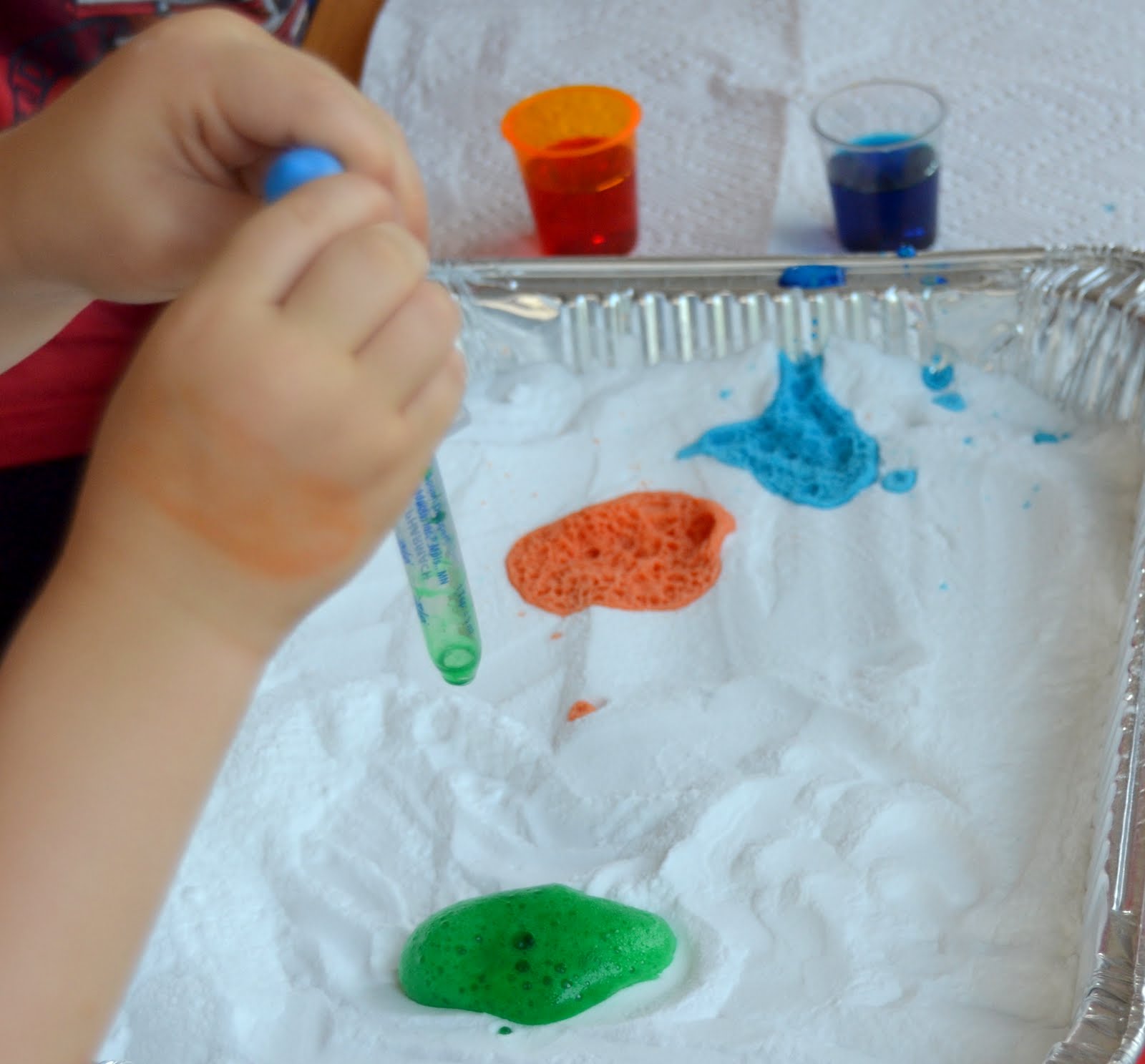
This really is fantastic to watch. The baking soda looks and feels beautiful to start with anyway, it's so soft and white. The fizzing of the chemical reaction (green in the above photo) is always fun, but when the bubbles subside, we're left with cratered patches of colour (the blue and orange above).
Your child will need to know how to use a dropper--though this is a good way to teach them. (I also recommend giving them a dropper or turkey baster in the water table / bath.) If they've not mastered that skill, expect some confusion and 'misplaced' vinegar.
If you want to get into the science of it, (or even if you don't, but want to be prepared for the inevitable day when your kids ask), there are 'simple' explanations of the baking soda / vinegar reaction here and here. The simplest I can reduce it to for mine is that it's a chemical reaction, which means the baking soda and vinegar are turning each other into other things. One of those things is a gas, and that's what makes the bubbles. That still goes over my four year old's head.
The End Result
I am fairly sure that older, more aesthetically conscious children, could produce a fantastic abstract piece of art with this, a surreal rainbow cratered landscape... What mine generally do is pile all their colours onto one spot making a mushy brown patch, with some squabbling over territory.

Please note that this took about five minutes, and included me refilling the cups once. This isn't really something that's worth the effort of set-up if you're looking to occupy them while you get on with something else. I have debated giving my son a small jug of vinegar and the food colouring so that he can refill their cups as needed (and experiment with mixing colours, if he so desires), but I am wary that my daughter will take matters into her own hands--a staining disaster waiting to happen.
I have managed to extend the game a little though....
Extension Activities
Given the chance, your child might well continue until all the baking soda is a saturated mish-mash of colour. If it's too swampy, this is the time to clean everything up, but otherwise, you've got something rather akin to rainbow sand. New sensory activity ahoy!

It really isn't the best medium, but you can mould it to an extent. My daughter lost interest, but my son spent about ten minutes using the now empty cups to make sandcastles. This does get messy, since once their hands go into the tray, the 'sand' will start coming out of it, and it might be better done out of doors--but I've never had a problem cleaning everything up again. It's baking soda and vinegar after all.
Thanks to the inherent cleansing attributes of the medium, even the smallest tots should be able to help clean up the mess afterwards. My children are expected to carry cups and droppers to the kitchen counter and use the paper towel to wipe up spills. I supply more towels as needed, empty the dish out and rinse everything off again.
Really, I should make the children do the washing up, but I am taking a break from cleaning up the puddles my daughter leaves on the floor.
For further art adventures in the baking soda / vinegar genre, check out this (probably best done outdoors) alternative: Exploding Paint Bags. This sounds amazing, but right now, I am far too much of a coward to actually try it out.
What You Will Need
- A large amount of Baking Soda (i.e. think in terms of cups, not teaspoons)
- Vinegar
- Food colouring
- A dish, tray, tub... (I use a disposable roasting dish, but it cleans off perfectly every time with just a quick rinse)
- Small cups/pots to minimise clean-up from spills (I use plastic shot-glasses; mini play-doh pots would be ideal since they are hard to tip over)
- Eye droppers
- Paper towels
- Instructions on how to get food colouring out of clothes (I can vouch for this method with inexact measurements used two hours after the initial stain--it probably helps that vinegar is involved from the start)
So here is our set-up. The first time I ever did this, I just put a thin layer of baking soda down and it was swamped by the amount of vinegar the children deluged it with. These days, I buy my baking soda from a wholesaler and I pour it approx 1cm thick.
I have two children, aged two and four, so they each have their own dropper and their favoured colours on their side. When I refill the cups, they may swap colours. If possible, it would probably be more effective to provide one eye-dropper per colour, since they can be a little careless about emptying the dropper before going to the next colour.
Directions:
Obvious enough...
- Step 1: Fill dropper with coloured vinegar.
- Step 2: Squeeze vinegar over baking soda.
- Step 3: Admire the result.
- Step 4: Repeat until supplies/attention span exhausted.
This really is fantastic to watch. The baking soda looks and feels beautiful to start with anyway, it's so soft and white. The fizzing of the chemical reaction (green in the above photo) is always fun, but when the bubbles subside, we're left with cratered patches of colour (the blue and orange above).
Your child will need to know how to use a dropper--though this is a good way to teach them. (I also recommend giving them a dropper or turkey baster in the water table / bath.) If they've not mastered that skill, expect some confusion and 'misplaced' vinegar.
If you want to get into the science of it, (or even if you don't, but want to be prepared for the inevitable day when your kids ask), there are 'simple' explanations of the baking soda / vinegar reaction here and here. The simplest I can reduce it to for mine is that it's a chemical reaction, which means the baking soda and vinegar are turning each other into other things. One of those things is a gas, and that's what makes the bubbles. That still goes over my four year old's head.
The End Result
I am fairly sure that older, more aesthetically conscious children, could produce a fantastic abstract piece of art with this, a surreal rainbow cratered landscape... What mine generally do is pile all their colours onto one spot making a mushy brown patch, with some squabbling over territory.
Please note that this took about five minutes, and included me refilling the cups once. This isn't really something that's worth the effort of set-up if you're looking to occupy them while you get on with something else. I have debated giving my son a small jug of vinegar and the food colouring so that he can refill their cups as needed (and experiment with mixing colours, if he so desires), but I am wary that my daughter will take matters into her own hands--a staining disaster waiting to happen.
I have managed to extend the game a little though....
Extension Activities
Given the chance, your child might well continue until all the baking soda is a saturated mish-mash of colour. If it's too swampy, this is the time to clean everything up, but otherwise, you've got something rather akin to rainbow sand. New sensory activity ahoy!
It really isn't the best medium, but you can mould it to an extent. My daughter lost interest, but my son spent about ten minutes using the now empty cups to make sandcastles. This does get messy, since once their hands go into the tray, the 'sand' will start coming out of it, and it might be better done out of doors--but I've never had a problem cleaning everything up again. It's baking soda and vinegar after all.
Thanks to the inherent cleansing attributes of the medium, even the smallest tots should be able to help clean up the mess afterwards. My children are expected to carry cups and droppers to the kitchen counter and use the paper towel to wipe up spills. I supply more towels as needed, empty the dish out and rinse everything off again.
Really, I should make the children do the washing up, but I am taking a break from cleaning up the puddles my daughter leaves on the floor.
For further art adventures in the baking soda / vinegar genre, check out this (probably best done outdoors) alternative: Exploding Paint Bags. This sounds amazing, but right now, I am far too much of a coward to actually try it out.
Friday, 12 July 2013
Time-Ins for Tantrums
Halfway down the stairs
Is a stair
Where I sit.
There isn't any
Other stair
Quite like
It.
- A. A. Milne Halfway Down
My tantrum education is going swimmingly, thanks mostly to my temperamental daughter. I hate to add my voice to the generalisation, but this is why people say girls are harder than boys. While it's in no way fun, it's given me ample motivation to analyse my relationship with the children and how that's reflected by my reactions to their temper loss.
Back in January I posted about dealing with tantrums, with the main conclusion being to stay calm and focus on getting them to calm down rather than on what caused the tantrum. Since then, both children have improved in their meltdowns, which is likely as much due to age as it is to my incredible parenting skills. However, I've adapted too. I became uncomfortably aware of just how much I was distancing myself from my children because they were losing their tempers. I didn't want to reward their inappropriate behaviour, but equally, I wasn't giving them the support they needed to find the correct response to the situation.
A First Step in Conflict Resolution
I pulled out an idea I'd mentally filed away back when my son was a baby/toddler: the concept of a time-in instead of a time-out. Instead of leaving your child on their own for a specified length of time, the parent sits with them and they talk through it together. (NB there are times when the time out is required so the parent can calm down; this obviously is not a viable alternative for those!)
I've never really gone in for time-outs anyway since I find them exhausting to enforce, but I used to send my son to his room when he was in his terrible twos, with the instruction that he could come out when he calmed down. He used to come out immediately, but the muscle-routine of going up and down the stairs was enough to work him out of his temper. That was all the calming he needed.
These days, he needs something more than a physical soothing; he wants to understand and to be understood. As for my daughter, going upstairs and back down again has never worked.
A few months back, I posted about how a loss of my temper as well as my daughter's ended with us both on the top step of the stairs, sitting calmly until my daughter was ready to go bed. This became our solution to bedtime protests for a month or so until gradually phased out. But the top step of the stairs (or the bottom, depending which floor we were on) was such a good neutral spot that I started using it for other things. I believe it was Supernanny who used the 'naughty step' for time-outs. The same principle of convenience works for time-ins, but now the step is acting more like a Montessori Peace Table.
 |
| My new favourite Parenting Tool |
A Time Out for Two (or Three)
Initially, I fell into using it for my son when he was acting up and I would have to remind him of the rules, or if he started protesting the rules. I would call him over to the step and my daughter would invariably follow, so the three of us would sit there while I tried to put the reasoning behind the rules into four-year-old logic (and, if necessary, toddler logic as well). It puts me on their level, hugs can be freely given, my lap is available and--perhaps most important of all--we are away from temptation / the scene of the crime.
The downside is that the step encourages fidgeting, shifting from step to step, and general squirming of embarrassment. I try and get my son to sit still and make eye contact, but I don't want to distract from the real issue--perhaps I should keep some fidget-soothers close by!
In general though, this has been very effective. I don't always remember to use it--and there are certainly times when I am just too wound up myself for a time-in (as is familiar to any stay-at-home parent, the children are not likely to grant me a time-out). Still, overall, this has worked well for us and we're having fewer genuine upsets.
What I should do in due course is to direct the children to go the steps when they are arguing with each other and talk through their dispute. I'm not sure my daughter's quite ready for that yet.
A Comfort Zone
My daughter, not quite two and a half, cannot be talked through her meltdowns in the way my son can. There are times when she gets completely hysterical and will scream and hit and kick and there's absolutely nothing we can do for her. Waiting it out doesn't work, as she generally goes until something distracts her--and that something won't necessarily work the next time. When she gets into that state, we generally spend about an hour trying to deal with it.
By far the most reliable method of soothing her is for my husband to take her while I disappear. She won't calm down for him, but when I return after a couple of minutes, I will be able to cuddle her and get her back in control of herself.
But when it's just me on my own? I have had limited success with holding her in front of a mirror, so she can watch herself as she cries which seems to give her some validation for her emotions. (Public restrooms, with their added soother of running water, are my refuge of choice when we are out and about during tantrumming). Walking away from her is useless since she will run after me and throw herself down again.
This was a huge concern for me for a few months. In worrying through the problem, I felt certain that consistency was going to be key in resolving this issue and that I had to use a soothing mechanism that we were in the habit of doing outside of tantrums--something familiar. So I started sitting down on the step.
I should make it clear that this does not have a 100% success rate, but it is a clearly established habit now. My daughter throws herself on the floor, and I go to the step and ask her if she wants to sit with me. She has the choice of sitting on the step next to me or on my lap, but she must sit herself down--I explain that it is not safe for me to pick her up when she isn't in control of her body. I also explain that if she kicks/hits me, then I will have to leave. (I generally move to the other end of the stairs if needed.)
I don't scold her for the tantrum, not even for the hitting. I don't spent a lot of time talking to or looking at her. I am just there. If she quietly presses up against me for comfort, I'll rub her back and help her sit down. Generally, once the storm has passed, we'll sit in silence, with her in my arms and her face resting against my shoulder. Increasingly often, she'll never build up a full head of steam but will sit down next to me quietly until she's ready to get on with whatever she was protesting. By this point, I can spot very quickly if this is a time when it's not going to work (though that's not much use without a plan B).
I'm such a scatterbrain that it's easy for me to be impatient with the children when I'm trying to focus on something else. Nevertheless, for the past few months I've been trying very hard to stop what I'm doing and make time to deal with angry children. It's not always possible, but I've come to the conclusion that that's the relationship I want to have going forward--talking through their moods with them rather than scolding them for their loss of control. (Why yes, my paranoia about teenager years is starting early!)
If nothing else, it's a big relief just to have a plan in the event of a meltdown. Not even the most hysterical of screaming children is worse than the helpless feeling when you have no idea what to do.
Subscribe to:
Posts (Atom)